Why haven't I written more about my job? Here's what it says in the materials they sent me:
"You are a neutral trial observer, bound to confidentiality, barred from public comment except to identify yourself as a trial observer, representing Lawyers Without Borders, an NGO based in the USA. Your goal is to observe a trial and you should do nothing, nor speak to anyone, that might jeopardize your permission to attend and observe the subject trial."
So that's that. Anyhow, it's finished now. Over three weeks of sitting in a very cold courtroom located on a prison compound, watching a trial that's been going for over a year, and has a long way to go. I am happy I did it. I learned a lot and I think I was helpful. I also learned that neutral trial observation is not the career for me. Good to know.
Thursday, July 2, 2009

Netball
It's like basketball, but without a backboard, dribbling, or serious defense. Bizarre. 
 Adios, Windhoek. Next stop, Botswana.

 Adios, Windhoek. Next stop, Botswana.
Chameleon Backpackers
Where I stayed in central Windhoek. It was a deal -- less than $10 per night.

This is the kitchen. Many nights, 5 or 8 of us would all contribute something and cook a big meal together.
I met lots of great people. For example, this past weekend I met a student named Chris, who wants to become a foreign correspondent in Africa. We hiked about 10 km in the hills outside Windhoek. Here's us near the end of the hike. And last night, I had a long chat with two guys who are staying here. One was an Australian doctor named Mark who had his car shipped from Australia to Chennai, India in 2004, and has driven from there to here, in Windhoek. He stops when he needs to earn money. He stayed in Sierra Leone for a year, and in Pakistan for 3 months, and he’s been home a few times in between. He just finished over two months in the Democratic Republic of Congo. He stayed in Kinshasa for a while, then got a motorbike and rode all over the East. Someone there told him he was the first tourist they had seen in years. He saw silverbacks (like 2 meters away!), rebels (almost as close), and lots of other stuff. His car is falling apart, and he will remain here until he fixes it. He has a policy of not paying bribes over $2. If asked for a bribe at a border, for example, he'll just ask where he can pitch his tent, and wait until he's allowed to pass. "They don't like people pitching tents at borders," he says. Here's a shot of Mark, taken from my tent.
 The other guy was Frenchman named David who has driven here from Paris. He left on January 7 of this year. Both Mark and David made it through Angola in 5 days on a transit visa -- which is apparently only available at one border crossing from the north. Here's a photo of David's spectacular car. He says people were especially nice to him because they were so impressed with it. One problem: It's so old and rare that nobody in Africa seems to have tires that fit it.

This is the kitchen. Many nights, 5 or 8 of us would all contribute something and cook a big meal together.

I met lots of great people. For example, this past weekend I met a student named Chris, who wants to become a foreign correspondent in Africa. We hiked about 10 km in the hills outside Windhoek. Here's us near the end of the hike.
 And last night, I had a long chat with two guys who are staying here. One was an Australian doctor named Mark who had his car shipped from Australia to Chennai, India in 2004, and has driven from there to here, in Windhoek. He stops when he needs to earn money. He stayed in Sierra Leone for a year, and in Pakistan for 3 months, and he’s been home a few times in between. He just finished over two months in the Democratic Republic of Congo. He stayed in Kinshasa for a while, then got a motorbike and rode all over the East. Someone there told him he was the first tourist they had seen in years. He saw silverbacks (like 2 meters away!), rebels (almost as close), and lots of other stuff. His car is falling apart, and he will remain here until he fixes it. He has a policy of not paying bribes over $2. If asked for a bribe at a border, for example, he'll just ask where he can pitch his tent, and wait until he's allowed to pass. "They don't like people pitching tents at borders," he says. Here's a shot of Mark, taken from my tent.
 The other guy was Frenchman named David who has driven here from Paris. He left on January 7 of this year. Both Mark and David made it through Angola in 5 days on a transit visa -- which is apparently only available at one border crossing from the north. Here's a photo of David's spectacular car. He says people were especially nice to him because they were so impressed with it. One problem: It's so old and rare that nobody in Africa seems to have tires that fit it.
What Windhoek looks like
Phoenix, but with fewer people. When you walk out of your home, or around a corner, you're likely to encounter a big, wide street with a few cars and not very many people. This is the view from very near our hostel shortly after dusk. It's on one of the busiest streets in town, a block or two from the district considered downtown. 
Robert Mugabe Ave. in downtown in the afternoon.
A main pedestrian walkway and tourist spot -- Independence Avenue.
A woman in traditional dress. People's attire ranges from fancy suits, to casual outfits, to a variety of traditional clothes. It's an impressive hodgepodge.
Zoo park, also in downtown. Rarely crowded, but a nice place to sit and read.
I have been cold since I arrived. It's the middle of winter in a desert climate. During the day, in the sun, it's warm or even hot, but the shade at midday is still a bit cold. And the temperature plummets when it gets dark.

Robert Mugabe Ave. in downtown in the afternoon.

A main pedestrian walkway and tourist spot -- Independence Avenue.

A woman in traditional dress. People's attire ranges from fancy suits, to casual outfits, to a variety of traditional clothes. It's an impressive hodgepodge.

Zoo park, also in downtown. Rarely crowded, but a nice place to sit and read.

I have been cold since I arrived. It's the middle of winter in a desert climate. During the day, in the sun, it's warm or even hot, but the shade at midday is still a bit cold. And the temperature plummets when it gets dark.
A typical day
Here's what a regular weekday would be like for me in Windhoek.
I wake up at 7 or 7:30. I pop my head out of the tent to look at the light to estimate what time it is because I don’t have a watch or cellphone and I don‘t want to turn my computer on to see what time it is. I get up, maybe take a shower (sometimes the water is hot, sometimes not), make myself some instant coffee and toast. Over breakfast, I chat with other people or surf the internet on my little computer. Then, I gather my notebook, ID card, and reading material, and head to court.
Outside, I stand on the street and get a cab. It costs 7.50N for a taxi ride -- about $1. I ask to be dropped at the Central Prison. I arrive, the gate opens, I sign in, and when court begins, I sit inside and watch. (The court is at the Central Prison. It was built, or more likely converted, to handle the trial I am observing. Court lasts until 4 on most days. Then, I take a cab back to my hostel, type up my notes from the day, and email them off to Lawyers Without Borders.
At night, I cook dinner or go out with the people from my hostel, Chameleon Backpackers. Then, it’s back to my tent for a snooze.
I wake up at 7 or 7:30. I pop my head out of the tent to look at the light to estimate what time it is because I don’t have a watch or cellphone and I don‘t want to turn my computer on to see what time it is. I get up, maybe take a shower (sometimes the water is hot, sometimes not), make myself some instant coffee and toast. Over breakfast, I chat with other people or surf the internet on my little computer. Then, I gather my notebook, ID card, and reading material, and head to court.
Outside, I stand on the street and get a cab. It costs 7.50N for a taxi ride -- about $1. I ask to be dropped at the Central Prison. I arrive, the gate opens, I sign in, and when court begins, I sit inside and watch. (The court is at the Central Prison. It was built, or more likely converted, to handle the trial I am observing. Court lasts until 4 on most days. Then, I take a cab back to my hostel, type up my notes from the day, and email them off to Lawyers Without Borders.
At night, I cook dinner or go out with the people from my hostel, Chameleon Backpackers. Then, it’s back to my tent for a snooze.
Crime in Windhoek
There's no shortage of alarmism about crime here. The employees at our hostel spend a lot of their time cautioning people about muggings.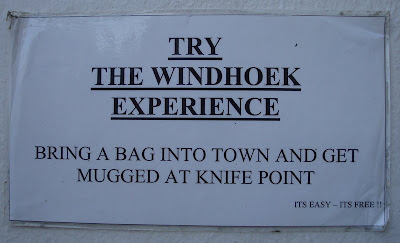
Fear of crime has a big effect on the landscape. It's full of barbed wire, electric fences, and walls.

Fear of crime has a big effect on the landscape. It's full of barbed wire, electric fences, and walls.

Wednesday, July 1, 2009
The Windhoek landscape
A few photos of the main decorations outside everyone's house. Whether it's a small cement-block structure in a township or a larger house on a hill near the city center, the one common element is intimidating protection against the outside world. 


For what it's worth, I walked all over town and took tons of local cabs -- and I never had any problems. Everyone I encountered was nice, or at least civil. Had I spent my entire time here behind gates and fences, I wouldn't have felt like I actually got to know the city.


For what it's worth, I walked all over town and took tons of local cabs -- and I never had any problems. Everyone I encountered was nice, or at least civil. Had I spent my entire time here behind gates and fences, I wouldn't have felt like I actually got to know the city.
What's in Windhoek
Windhoek does have the occasional monument. Here's the Equestrian Statute, commemorating German soldiers killed during the wars to subdue the Nama and Herero tribes from roughly 1903-1907.
A nice catholic church.
Parliament
The only place that really draws a crowd: Kentucky Fried Chicken, where it can easily take 45 minutes to stand in line, order food, and finally receive it.
Here is the view from inside Windhoek's less fancy mall. You're looking at the Pick and Pay, an immaculate grocery store within the mall.

A nice catholic church.

Parliament

The only place that really draws a crowd: Kentucky Fried Chicken, where it can easily take 45 minutes to stand in line, order food, and finally receive it.

Here is the view from inside Windhoek's less fancy mall. You're looking at the Pick and Pay, an immaculate grocery store within the mall.

Windhoek, Namibia
Namibia is about the size of Alaska. 2 million people live in the entire country.
Windhoek, the capital, has about 230,000 people. Windhoek is located roughly in the middle of the country, and it reminds me (and a lot of other people) of Phoenix.
Here are a few pictures of Windhoek from a distance. (The church you can see in the second picture is at the corner of Fidel Castro St. and Robert Mugabe Ave.)


Windhoek stretches from south to north. There's something of a downtown near the middle, a university on the south, and a "township" in the northwest called Katatura. Townships are poorer neighborhoods with high population density. Katatura is rumored to have more people living in it than the rest of Windhoek combined.
Windhoek, the capital, has about 230,000 people. Windhoek is located roughly in the middle of the country, and it reminds me (and a lot of other people) of Phoenix.
Here are a few pictures of Windhoek from a distance. (The church you can see in the second picture is at the corner of Fidel Castro St. and Robert Mugabe Ave.)


Windhoek stretches from south to north. There's something of a downtown near the middle, a university on the south, and a "township" in the northwest called Katatura. Townships are poorer neighborhoods with high population density. Katatura is rumored to have more people living in it than the rest of Windhoek combined.
Aid Workers in Africa
In When a Crocodile Eats the Sun, Peter Godwin describes an elephant expert from the United States named Loki, who comes to Zimbabwe to work help villagers in the Dande tribal area in the Zambezi Valley. Godwin writes:
“As they have only one spring, and walk miles each day for water, Loki says he wanted to help them by sinking a well. They welcome the idea, though doubt he can pull it off. When his borehole-drilling crew finally hits water, the villagers start feuding furiously about the altered walk-to-water hierarchy, and Loki is eventually forced to fill the well back in. Now the tribeswomen once again spend hours each day trudging to fetch water, and calm has returned.
“It’s always instructive to observe the life-cycle of the First World aid-worker. A wary enthusiasm blooms into an almost messianic sense of what might be possible. Then, as they bump up against the local cultural limits of acceptable change, comes the inevitable disappointment, which can harden into cynicism and even racism, until they are no better than the resident whites they have initially disparaged.”
“As they have only one spring, and walk miles each day for water, Loki says he wanted to help them by sinking a well. They welcome the idea, though doubt he can pull it off. When his borehole-drilling crew finally hits water, the villagers start feuding furiously about the altered walk-to-water hierarchy, and Loki is eventually forced to fill the well back in. Now the tribeswomen once again spend hours each day trudging to fetch water, and calm has returned.
“It’s always instructive to observe the life-cycle of the First World aid-worker. A wary enthusiasm blooms into an almost messianic sense of what might be possible. Then, as they bump up against the local cultural limits of acceptable change, comes the inevitable disappointment, which can harden into cynicism and even racism, until they are no better than the resident whites they have initially disparaged.”
Subscribe to:
Posts (Atom)
